

5 Challenges Facing Dairy Processing Industry in 2026
.webp)

.svg)
5 Challenges Facing the Dairy Processing Industry in 2026
Dairy has never had more demand or less margin.
Dairy processors have poured more than $11 billion into new and expanded US dairy plants over the last five years — Leprino's billion-dollar Texas facility running 8 million pounds of milk a day, Fairlife's $650 million plant in New York, Great Lakes Cheese, Daisy Brand, Darigold, Walmart.
The demand justifying that capital is real: retail milk sales rose nearly 5 percent in value in 2025 and 88 percent of US dairy executives now name protein as the single most influential consumer demand trend. And yet nearly 70 percent of surveyed dairy companies reported flat or shrinking margins in 2025, up from 66 percent the year before.
Here are some trends in the dairy and dairy processing industry:
- Booming category demand: high-protein dairy growing at a 17% CAGR since 2019 puts capacity pressure on manufacturers to produce more SKU varieties.
- Record capacity investments: $11 billion invested into US dairy plants in five years.
- Compressing margins: 70% of dairy processors reported flat or shrinking margins in 2025.
- Widening SKU portfolios: protein shakes, cottage cheese, flavored milk, and ice cream running through the same lines, forcing manufacturers to be more agile with little to no margin of error.
More capacity doesn't fix an old problem. Most of what limits a dairy plant happens in the gaps between production: during Clean-in-Place, during product changeovers, during the minutes nobody counts.
Here are five of the biggest challenges reshaping dairy manufacturing in 2026.
#1 Static, Timer-Based CIP Cycles Consumes Too Much Production Time
Most dairy plants still clean to a fixed, timer-based setpoint rather than to the real condition of the line.
Clean-in-place recipes get written for the worst case a line is ever likely to see — the heaviest soil load, the most stubborn residue, the batch that sat too long on a warm afternoon — and then they run exactly that way every cycle, regardless of what actually went through the pipe. Dairy runs those cycles more often than almost any other category, typically every 24 to 48 hours, because milk proteins and the heat-set soils that come off pasteurization are significant quality hazards.
That conservatism is rational. A contamination event in dairy costs far more than an extra fifteen minutes of caustic, and quality teams are right to build in margin when they have no way of seeing what's actually inside the line while it's running.
The problem is that the margin compounds. Conductivity sensors track chemical concentration reliably enough, but they say nothing about whether protein residue has actually cleared, so the buffer stays in the recipe and the cycle runs long on every line and every shift whether the equipment needed it or not. In most dairy plants, somewhere between 15 and 20 percent of the time spent on CIP is efficiency nobody is capturing, and because it was designed into the recipe years ago, nobody is looking for it either.
#2 Product Changeovers Send Too Much Good Product Down the Drain
Every transition between two products loses saleable product twice.
At the tail of a run, finished product gets pushed toward the drain before the timer calls the line clear, and at the head of the next run, enough of the incoming product has to push through before anyone can safely assume what's coming out is pure. In flavored milk and ice cream, where a plant might run chocolate, strawberry, and vanilla through the same line in a single shift, those transitions stack up quickly and each one takes its cut at both ends.
Turbidity sensors catch the obvious break between product and rinse water, but they struggle to reliably distinguish chocolate from strawberry, or one fat grade from the next, because to an instrument measuring cloudiness the two look close to identical. Without a clear signal, the safe move is to flush wide and write the difference off as shrink.
Finance sees that loss as the gap between what the inputs should have produced and what actually shipped, which means the cost is visible in aggregate and invisible at the point where it happens. As SKUs multiply and run lengths get shorter, the number of transitions per shift keeps climbing, and every one of them repeats the same small, unmeasured loss.
#3 Milkfat Giveaway Erodes Margin on Every Batch
For decades, dairy producers have protected themselves from compliance risk by giving cream away.
Over-delivering on milkfat is the safest way to guarantee every unit meets its declared grade, because standardizing slightly rich means no batch ever comes in under spec. It's a sound instinct, it keeps the product consistent, and it's been standard practice long enough that most plants no longer treat it as a decision anyone is actively making.
It's also a direct transfer of margin out the door on every batch produced. Quality testing can reveal fat content of dairy products such as milk, but reading a number isn't the same as acting on it, and a human still has to interpret the value and make the dosing call at a pace no operator can sustain against a line running at production speed.
The result is a plant that knows its required fat percentage and still can't ensure it reliably batch after batch, so they overdeliver milk fat to make sure they are within required thresholds. The giveaway is small on any single unit and substantial across a year, and it causes significant loss of revenue, especially when margins are already under pressure.
.png)
#4 One Undetected Leak Costs an Entire Shift
Ask dairy plant managers what actually disrupts a week and cream leaking into the glycol system comes up fast.
The leak itself is small, but the consequences aren't. Once product gets into the loop it fouls the system, cooling performance degrades, lines can ice up, and product starts leaving the cooler above its temperature limit — which typically ends in a mass dump, hours of cleaning, and labor-intensive stopgaps, all set off by something nobody could see until its effects arrived downstream.
The same pattern holds for underwash. A cleaning step that advances a few seconds early leaves residue that no one catches until a quality sample comes back from the lab, and by that point the affected product has already run.
Detection is the whole problem here, and it isn't a shortage of procedures or of skilled people. Most sensor deployments in dairy today exist to help mitigate errors after the fact rather than to catch them while there's still time to act.
#5 Wastewater Compliance Still Rests On One Person's Judgment
The most finely tuned system in many dairy plants is a single operator's intuition.
Wastewater operations have to hold Biological Oxygen Demand (BOD), Chemical Oxygen Demand (COD), Total Suspended Solids (TSS), and Fats, Oils, and Grease inside compliance limits every day, which means adjusting chemical dosing, flow rates, and equipment behavior continuously as conditions change. The people who do this well are genuinely good at it, and they've spent years learning how their particular plant behaves.
As regulatory pressure tightens, leaning entirely on individual judgment starts to invite penalties, clogs, and costly reprocessing, and a plant that loses its wastewater operator loses decades of undocumented calibration along with them.
Every one of these five challenges shares the same root. The plant is running on assumptions about what's inside the pipe, because until recently there was no practical way to know.
Process-Aware Automation for Dairy Operations
Running process-aware AI and dynamic processes in your facility doesn't require new plumbing, new chemistry, or a new control philosophy. It requires a signal that tells the plant what's actually flowing through the line in real time, and a model trusted enough to act on it.
Laminar's process-aware spectral sensors clamp onto existing dairy lines and continuously read the condition of the fluid in the pipe, identifying rinse water, soiled caustic, clean caustic, distinguishing between whole milk, 2% milk, and product-to-product interfaces by their spectral signature. Laminar ML models, grounded in chemistry and built on millions of observed cycles, weigh that signal and communicate step-advance decisions back to the PLC. Nothing about the existing plumbing, recipes, or quality frameworks has to change, and if the system ever falls outside expected parameters it reverts to the original timer-based recipe.
Dynamic Clean-in-Place: Cycles end the moment residue clears rather than when a worst-case timer expires, so steps advance on measured condition and each cycle uses less water, chemicals, and energy while still meeting the same quality standards.
Faster Product Changeovers: The models detect the exact product-to-product and product-to-water interface, recovering good product at both the tail and the head of every transition, including the subtle changes like chocolate to strawberry that turbidity can't resolve.
Inline Product Specification Monitoring: Models trained on the spectral signatures of milk at defined fat grades make sub-second dosing adjustments, holding fat percentage inside spec without giving cream away on every batch.
Instant Underwash and Contamination Detection: Sensors on the glycol return loop catch cream leaking into the system within seconds and alert your operators turning what would have been a lost shift into a caught deviation. The same models flag underwash long before it reaches a quality sample.
Proactive Wastewater Routing Optimization: Spectral and conventional sensor inputs across input streams, reactors, and sludge filters feed sensor-specific models that regulate valves, dosing, and flow, keeping BOD, COD, TSS, and FOG in compliance without relying on one person's judgment.
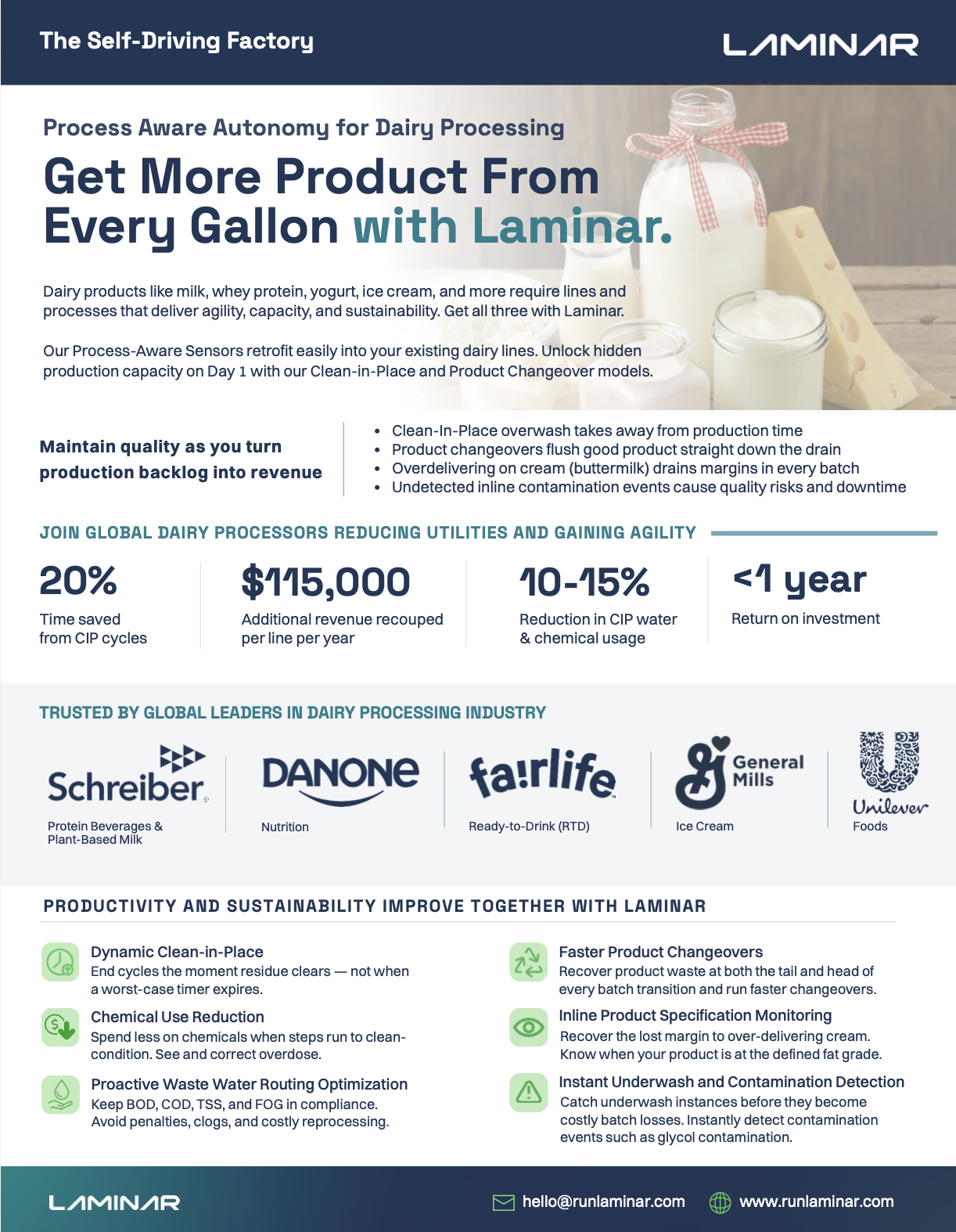
Across global dairy deployments, Laminar customers see 20% time saved from CIP cycles, 10–15% reductions in CIP water and chemical usage, and roughly $115,000 in additional revenue recouped per line per year, with return on investment typically inside twelve months.
"[Laminar] has helped our foods factory in Poznan, Poland, cut utility use by 10%, reduce machine cleaning times by 20% and save €100,000/year. This is one of the most successful pilots to come out of 100+ Accelerator, a unique partnership created by Anheuser-Busch InBev and co-sponsored by Unilever, Coca-Cola, Colgate-Palmolive and Danone."
Dairy's Next Gain Is Physical AI
Dairy in 2026 brings more SKUs through the same lines, tighter margins on every unit, and rising regulatory pressure on plants that were built for a much narrower product range. The $11 billion going into new capacity will help, but building more lines doesn't recover the production hours the existing ones are already losing to cleaning cycles that run longer than they need to.
The processors that outcompete won't be the ones that pour the most concrete. They'll be the ones that capture the minutes, gallons, and cream points already moving through the plant every day, without giving up any of the sanitation standards dairy depends on.
Want to see how leading dairy manufacturers are recovering production time while still complying with their sanitation requirements? Check out our Dairy One-Pager.
Frequently Asked Questions
What are the biggest challenges facing dairy manufacturing in 2026?
The biggest challenges facing dairy manufacturing in 2026 are timer-based CIP cycles that consume production time, product changeover losses from imprecise transition detection, milkfat giveaway that erodes margin on every batch, contamination and underwash events that cost full shifts, and wastewater compliance that still depends on individual operator judgment. Each one traces back to the same gap: plants make decisions based on assumptions about what is inside the pipe rather than real-time measurement.
How often do dairy plants run clean-in-place cycles?
Dairy plants typically run clean-in-place cycles every 24 to 48 hours, more frequently than most other food and beverage categories. The high frequency reflects the soils involved — milk proteins, fats, and heat-set residues from pasteurization require aggressive cleaning. Most dairy facilities run 5-step or 7-step CIP programs with both caustic and acid phases, which is also why CIP consumes a larger share of available production time in dairy than almost anywhere else.
What is milkfat giveaway in dairy processing?
Milkfat giveaway is the practice of standardizing product slightly above its declared fat grade to guarantee that no batch falls below spec. It protects against compliance risk and keeps product consistent, but it transfers margin out of the business on every unit produced. Because existing sensors display fat content without acting on it, correcting giveaway has historically required manual intervention that cannot keep pace with line speeds.
Related Blog Posts
Future-Proofing Dairy Manufacturing with Science-Led AI
Clean in Place (CIP): The Complete Guide


