

Running 100 Flavors a Day: Why Rapid Changeovers Are the Biggest Bottleneck

.webp)

.svg)
Rapid product changeovers in food and beverage manufacturing are the biggest contributor to capacity constraints in today’s production facilities.
As product variety explodes and ingredient costs rise, inefficiencies during each product-to-product transition increase changeover time, drain good product, and reduce production capacity.
Key Takeaways
- The post-COVID product variety explosion is here to stay: Since 2020, consumer preferences require more flavors, smaller runs, and faster production cycles. The shift from a few hero products to hundreds or thousands of SKUs per line fundamentally increases changeovers for food and beverage manufacturers.
- Rapid changeover waste hits the bottom line twice: Product loss occurs at both the tail of the outgoing run and the head of the next one. Because most plants rely on timers and manual judgment, good product frequently goes down the drain before and after each transition.
- Fragmented time savings rarely translate into real capacity: Saving a few minutes per changeover only matters if those minutes consolidate into usable production windows that enable additional runs.
- Static, timer-based schedules cannot keep up with SKU complexity Institutional knowledge works when sequencing a handful of flavors. Even expert knowledge cannot optimize when plants run hundreds of SKUs with pressure on every shift to deliver targets.
- Manufacturers need solutions for self-optimizing changeovers: Visibility into real-time changeover conditions enables operators to optimize for the end of product flushes and start the next production run faster. The result is reduced product loss and greater production capacity.
From One Protein Tub to Eight RTD Flavors: What the Costco Shelf Tells Manufacturers
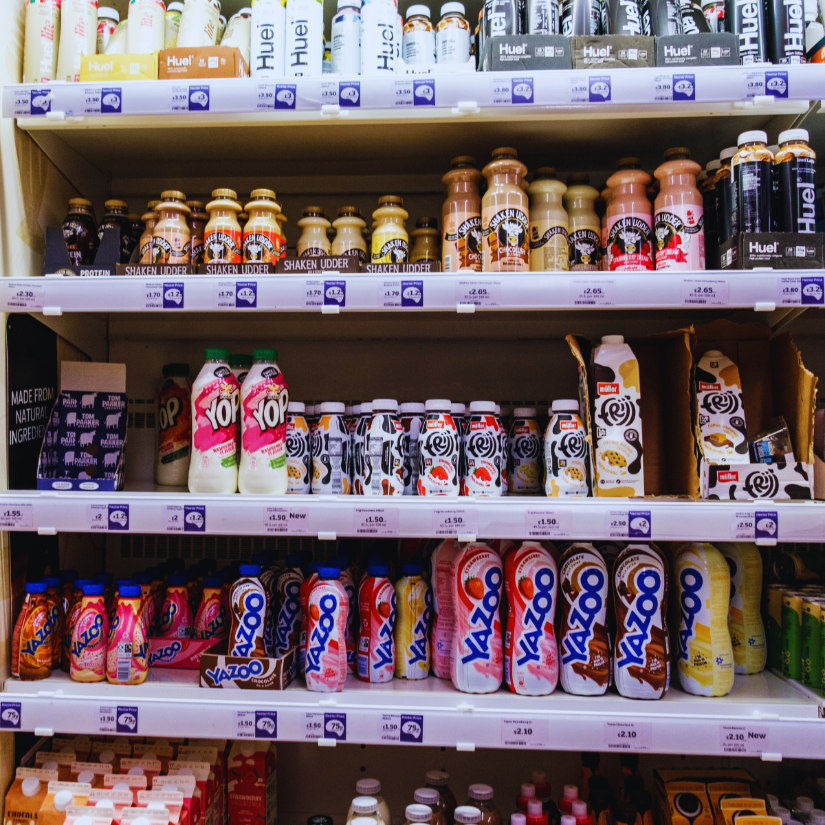
A few months ago, I spotted a large tin of whey protein isolate at Costco for around $20 — a fraction of what the same product costs elsewhere. Last week, the single, large product was gone, replaced by a wall of ready-to-drink (RTD) protein shakes in eight flavors, smaller containers, and higher unit prices.
That wall of eight RTD protein flavors at Costco represents a production line somewhere running eight changeovers where it used to run one — and every one of those transitions has a cost.
How Changing Consumer Preferences Are Driving SKU Growth in Food & Beverage
As recently as six years ago, the protein powder market was saturated with brands undercutting each other on margin to the point where even major players were feeling the squeeze. RTD was the escape hatch: take the same consumer, the same purchase occasion, and restructure it into eight repeat transactions at a higher unit price — while giving people the convenience they genuinely want.
A Bellwether: The Ready-to-Drink Protein Beverage Market
Busy schedules and on-the-go lifestyles made convenience a real purchasing driver, not just a marketing angle. The RTD protein beverage market hit $1.7 billion in 2024 and is projected to approach $3 billion by 2033. Pineapple overtook lime as the most popular new product flavor in 2024. Today the variety engine, fueled equally by consumer demand and brand economics, is running hot.
Consumer preferences and brand economics permanently shifted in the same variety-obsessed direction — SKU proliferation, shorter runs, faster cycles— and manufacturers are trying to keep up on equipment and processes that were never designed for this volume of transitions.
One sauce manufacturer I spoke with recently went from 300 to 3,300 active SKUs over roughly a decade. Up to 21,000 new food and beverage products are introduced in the US each year, and that pace isn't slowing.
Rapid SKU growth is fundamentally rewriting the rules of process manufacturing.
Hitting Capacity Limits: How Food Processing Plants Handle SKU Growth Today
Most food and beverage plants built their changeover sequences over years of trial, error, and accumulated experience. Operators know the conventional order for running flavors by feel: orange and orange-lime run well back-to-back because carryover risk is low; cherry before orange means a longer flush.
For a stable catalog with a few hero products, experienced operators can adapt lines for occasional SKU changes using institutional process knowledge.
Unfortunately, skill and manual oversight aren’t scalable. As plants begin running hundreds of SKUs, the complexity quickly outpaces what any team can track manually. Each changeover has its own residue pattern, carryover risk, and cleaning profile.
When new products are inserted into the production schedule, teams often rely on an educated guess for the optimal changeover sequence. Product or changeover issues are then discovered after the fact, and the typical response from quality teams is to add more buffer time to the flush. Over time, these seemingly small adjustments across hundreds of SKUs quietly stretch changeover windows and reduce available production capacity.
Why Traditional Methods Fail to Reduce Changeover Time
Plants often try to fix the changeover creep by tightening static timers, adding more sensors, or bringing in consultants to optimize the sequence. But these approaches rarely solve the underlying problem. Timer-based recipes are built around worst-case assumptions, so new SKUs inevitably mean more buffer time. Additional sensors or tweaking recipes may generate more retrospective data, but they still don’t provide real-time visibility into what is actually flowing through the line during a changeover.
The result is the same cycle: longer flushes, conservative cleaning steps, and lost production time.

Compounding Cost of Changeovers for Co-Manufacturers
SKU growth problem compounds even more for plants that don't control their own product mix.
For co-manufacturers and co-packers, the changeover pressure is especially intense. Customer demand now ranks as the primary operational challenge for 19% of manufacturers, nearly double the prior year.
Co-manufacturers might be running a signature sauce for a major fast-food chain, a dip for a competing burger chain, and a caramel for a coffee brand — all on the same equipment in the same week. When any one of those customers decides to add ten new flavors to the next batch, co-manufacturer absorbs added changeover costs.
This rapid SKU growth compounds operational pressure in three critical ways: lost product, lost time, and increased resource consumption.
#1 Product Shrink Lowers Profitability
Here's what most conversations about product changeover optimization miss: product is lost twice on every transition, and most of that loss never shows up on a dashboard.
Let's take ketchup changeover as an example: At the tail of a production run, Light Ketchup (Product A) is done and the water flush begins. Good finished Product A gets pushed out of the line before the timer-based cycle calls it clean — time lost is easy to measure, but the good product and water going directly to drain rarely gets tracked at all.
At the head of the next run, Regular Ketchup (Product B) comes in. Enough of it has to push through the line before anyone can safely assume what's coming out is pure Product B, ready for bottling. Again, good product goes to drain before a single bottle is filled.
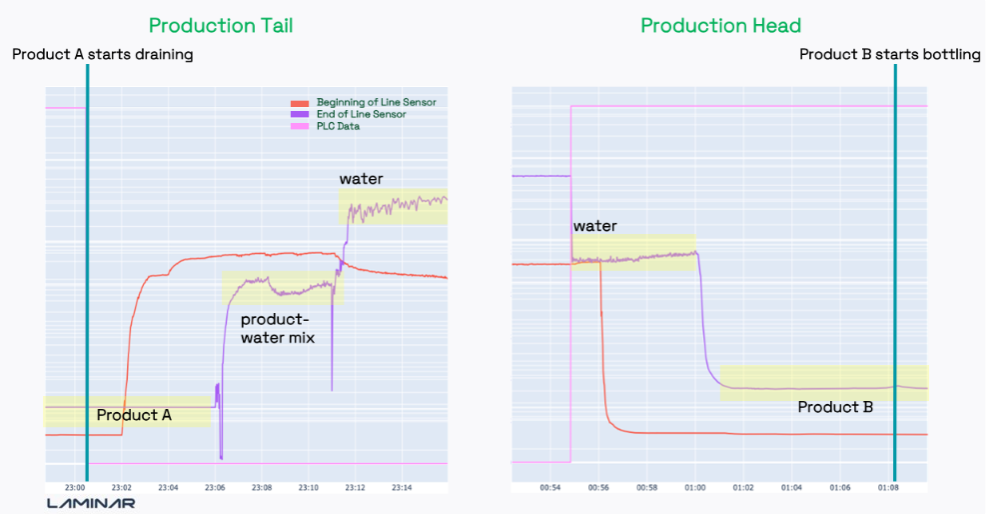
Finance tracks this as product shrink — the delta between what inputs theoretically produce (bottles/cans) and what actually ships. For a given set of inputs, what is the maximum a plant could have produced? What did it actually produce?
For plants running dozens or even hundreds of flavor transitions per day, that shrink compounds quickly. Back-of-envelope calculations on annual product loss due to changeovers have run into seven figures.
#2 Time Loss Reduces Production Agility
Saving ten minutes per changeover sounds meaningful until those ten minutes turn out to be scattered across a twelve-hour shift with no room in the schedule to absorb them. An additional production run doesn't open up in ten-minute increments. The savings may exist on paper but remain invisible in practice.
The question worth asking isn't just how to reduce changeover time — it's whether the time being recovered can be consolidated into a usable production window.
That's why when we sit down with plant teams, we try to get the scheduler in the room. Looking at a full week of production, a scheduler can often cluster those recovered minutes into a usable window — enough time for an additional run.
This sequencing problem gets harder with every new SKU. A dozen flavors and experienced operators can hold the optimal sequence in their heads. Add fifty more and the combinations multiply faster than any team can track manually.
A dye-heavy or sticky concentrate gets slotted somewhere that seems reasonable. It runs, and no one realizes it’s sitting in the wrong spot and driving unnecessary flush time from flavor carryover on every cycle.
Without a quantifiable feedback mechanism connecting what happened during each changeover to the production schedule, inefficient sequences that eat up production uptime get repeated week after week.
Production Agility is a Non-Negotiable for Faster Changeovers
Agility is the capability to say yes when a customer calls and says they're adding ten flavors to the next batch — because that's more revenue. But saying yes means adjusting production sequences for ten new SKUs, which requires available capacity in the system.
Adding ten new SKUs isn’t growth if the changeover process is dominating production time. These new flavors are now a capacity crisis with downstream pressure on quality, labor, and margins.
#3 Clean-Label Inputs Go into Unsustainable Processes
Clean-Label Reformulation Raises Input Costs
As consumers pushed for cleaner labels, manufacturers moved away from artificial colorants, synthetic preservatives, and cheap flavor boosters. Natural colors and flavors carry a higher price tag than their synthetic equivalents, and plant-based proteins cost significantly more than commodity whey did five years ago. 45% of global consumers prioritize nutrition and wellness over price, with Gen Z and Millennials willing to pay a meaningful premium for natural, clean-label products.
Tariffs Add Further Cost Pressure
Recent tariffs have pushed input costs higher across raw ingredients, packaging materials, and transportation. Many of the inputs most affected are precisely the premium clean-label ingredients manufacturers adopted in recent years.
Sustainability and Profitability are Mutually Reinforcing
When changeovers rely on static timers and conservative flush cycles, good product is regularly pushed to drain. Large volumes of water, cleaning chemicals, and energy are also used to wash the line between runs. As SKU counts grow and transitions become more frequent, those resource demands multiply.
The result is a paradox. Products may be more human-friendly, but the processes used to manufacture them can become less environmentally sustainable.
The flip side is equally important: improving changeover efficiency improves both sustainability and profitability at the same time. Every gallon of product recovered, every minute of flush time eliminated, and every cleaning cycle shortened reduces raw material loss, water consumption, chemical use, and energy demand simultaneously.
In other words, better changeover efficiency aligns cost control, operational efficiency, and sustainability in the same direction.
Real-Time, Inline Visibility Unlocks Self-Optimizing Changeover Processes
The core problem with how changeovers get managed today: decisions come from fixed assumptions, not from what's actually moving through the pipe.
Timer-based cycles dictate when a line should be clean based on a pre-set clock, not actual pipe conditions. Static sequences reflect what a transition looked like last time, not what production line is doing in real-time.
When Ten New Flavors Means a Capacity Crisis
The more stubborn version of this problem lives in new flavor introductions. When a sauce manufacturer introduces a new flavor, the quality team builds a conservative recipe — one biased toward not shipping a bad product, which is the right call. But that conservatism stays in the recipe without a feedback mechanism.
Product quality monitoring and shrink reduction are both achievable when operators run self-optimizing product changeovers that autonomously correct based on real-time changeover conditions instead of pre-set, worst-case recipes.
Laminar's Self-Optimizing Changeovers for Rapid Changeover Environments
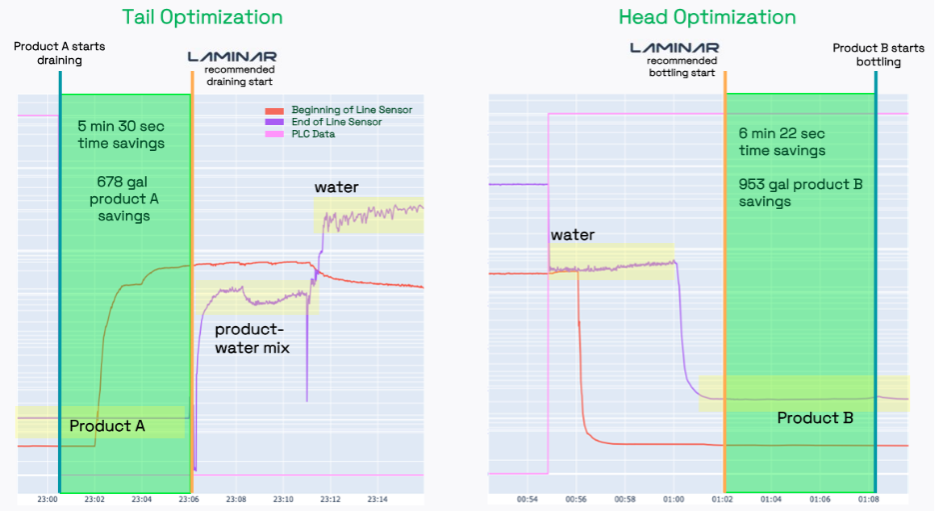
Laminar's inline spectral sensors and product changeover ML models give operators real-time visibility into what's moving through the pipe — tracking the actual product-water interface as it travels through the line.
Operators know exactly when the tail of Light Ketchup (Product A) has cleared and when Regular Ketchup (Product B) runs pure, rather than waiting out a conservative timer built around worst-case assumptions.
In practice: Laminar's changeover models identified good Light Ketchup still present in the line 5 minutes and 30 seconds after the timer-based recipe called for draining — saving 678 gallons of Light Ketchup on the tail alone. On the head, the models confirmed pure Regular Ketchup running through the line 6 minutes and 22 seconds before the timer-based recipe would have started bottling, saving 953 gallons of Regular Ketchup from going to drain.
The Scheduling Opportunity
Real-time visibility into changeovers also creates opportunities for the schedule. When changeover time savings are visible to the people making production plans, not just the plant floor, those per-changeover savings consolidate into real capacity. An extra batch per shift. The ability to say yes to ten new flavors without triggering a capacity crisis.
The F&B plants getting ahead of this are connecting three things: real-time changeover data, dynamic sequencing based on actual conditions rather than static recipes, and scheduling visibility that lets planners see the opportunity.
Find out where your changeover process is leaving production time and product on the table. Read more about Laminar’s Product Changeover Optimization.
Frequently Asked Questions
What causes product loss during product changeovers?
Product loss occurs at two points during every changeover: the tail of the outgoing product and the head of the incoming product. Because many plants rely on timer-based flushing, good product often goes to drain before the line is fully cleared or before the new product runs pure.
What is production agility in food and beverage manufacturing?
Production agility in food and beverage manufacturing is the ability to quickly adapt production lines to changing demand, new SKUs, and frequent product changeovers without losing efficiency. Agile F&B plants can run more flavors and shorter production runs while maintaining production uptime.
How do food manufacturers reduce changeover time?
Food manufacturers reduce changeover time by optimizing production sequencing, improving cleaning processes, and using real-time monitoring technologies. Solutions like Laminar’s inline ML-powered sensors provide real-time visibility into the product-water interface during transitions, allowing operators to stop flushing sooner, start the next run earlier, and significantly reduce both changeover time and product loss.
Related Blog Posts

From Static CIP to Closed-Loop Optimization: How F&B Plants Get More Agile Instantly

From 300 to 3,300 SKUs: When Clean-in-Place Becomes the Bottleneck
.png)


