5 Challenges Facing Beer Manufacturing in 2026
.webp)

.svg)
5 Challenges Facing Beer Manufacturing in 2026
The playbook that built modern brewing industry is over. Today, there’s a clear line between the companies that spent the last decade trying to mitigate decline and those with a clear path to innovate their operations out of survival mode and into growth.
Heineken announced plans to cut up to 6,000 jobs in early 2026 as the company pushed for major productivity savings amid weakening beer demand. AB InBev also moved aggressively to consolidate operations, closing breweries in Fairfield, California and Merrimack, New Hampshire while repurchasing roughly $3 billion worth of U.S. metal-packaging assets it had previously sold off. A decade ago, the dominant industry strategy centered on scale and acquisition. Increasingly, large brewers are now re-evaluating supply-chain resilience, manufacturing control, and operational efficiency as core strategic priorities
Slowing category growth (US beer down 13% since 2016/17). Rising utility costs (industrial electricity up 30%+ since 2020). Fragmented demand (NA alternatives forecast to grow 50% by 2030). Production variability (premium + NA + RTD all running through the same lines).
Here are five of the biggest challenges reshaping beer manufacturing in 2026.

#1 Consumer Shifts Drive Greater Beer Diversification
The modern brewery no longer produces just a handful of flagship beers.
RTDs, flavored beverages, non-alcoholic products, and seasonal releases mean every brewer faces expanded SKU portfolios and continue gaining share by moving quickly on flavor innovation and niche consumer trends, forcing larger manufacturers to increase agility across operations.
While diversification and SKU proliferation creates new growth opportunities, producing more products also introduces greater operational complexity inside facilities originally designed for narrower production ranges.
More product variability means more Clean-In-Place (CIP) cycles, more product changeovers, greater contamination sensitivity, and increased pressure on utility-intensive operations like filtration and Clean-In-Place.
#2 Water and Energy Scarcity Upend Long-Standing Brewery Operations
As AB InBev says, “No water. No beer.”
Reliable water and energy define the production envelope of every brewery. That envelope is shrinking fast in the regions where most US beer gets made.
Water Crisis Hits the Top Beer-Producing States First
Water reduction in beer manufacturing is now the leading sustainability goal across enterprise level, global brewers like AB InBev. This urgency comes from water and energy constraints that are rising globally and brewers now face existential risks that carry the potential to slow, pause, or even end operations all together.
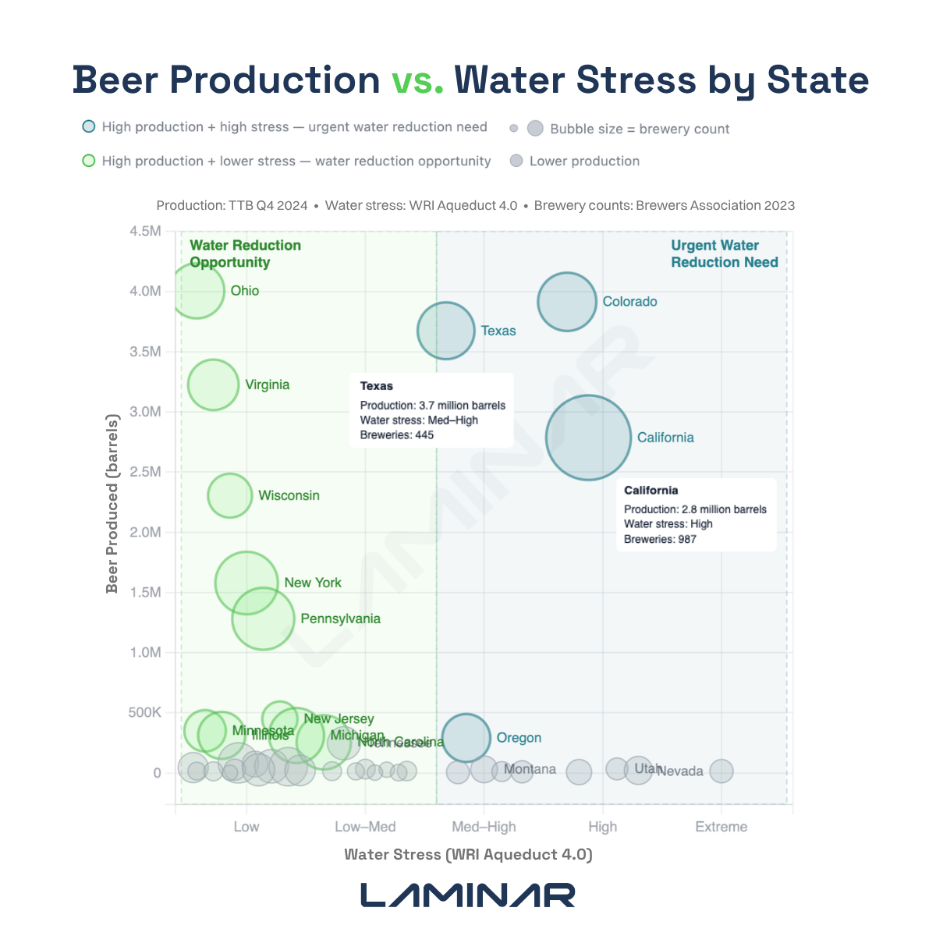
Take Colorado, Texas, and California — these states are the country’s largest beer-producing states and also some of the country’s highest water stressed regions. This very real resource crisis is at a tipping point in the Colorado River.
The Colorado River — which supplies 40 million people and irrigates the barley belt — sits at its lowest level since the reservoirs were filled. Lake Mead and Lake Powell are projected to hit deadpool conditions within the decade absent dramatic cuts, and the Bureau of Reclamation has already forced mandatory reductions on Arizona, Nevada, and Mexico.
Beer is a utility-intensive product. The brewing process amplifies that — most water and energy use happens outside the final product, during cleaning, sanitation, filtration, and product transitions.
Utility Bills Now Eat Margin That Used to Be Profit
Industrial electricity rates have climbed significantly since 2020, while municipal water and wastewater costs continue to rise across major brewing regions. As ingredient, packaging, labor, and utility costs increase simultaneously, many breweries are seeing utilities become a materially larger share of operating expenses than they were pre-pandemic.
As utility costs and constraints rise, eliminating water and energy waste is existential for the brewing industry. Operational visibility and solutions to battle excess water and energy use during production is mission critical.
#3 Rising Input Costs = Greater Margin Pressure
Input volatility has reshaped brewery economics across the supply chain.
Barley, packaging materials, transportation, ingredients, chemicals, and utilities remain elevated compared to pre-pandemic baselines. At the same time, many breweries are operating in a lower-growth highly competitive market where pricing alone is no longer enough to offset rising costs.
Input-cost volatility has become structurally embedded across brewing operations. Malt and barley pricing remain elevated relative to pre-2020 baselines, aluminum packaging markets continue to experience tariff and supply-driven swings, and diesel volatility has introduced greater uncertainty into freight economics across the supply chain. A slower market and expensive inputs amplify the cost of every operational inefficiency.
Excess rinse time, unnecessary chemical usage, avoidable product loss, and extended downtime now carry significantly greater financial impact than they did several years ago during industry boom times
#4 Retirees Walk Out the Door with Decades of Operational Expertise
Brewery operations depend heavily on operator experience and institutional knowledge built over decades.
The Bureau of Labor Statistics projects food and beverage manufacturing will lose nearly a quarter of its workforce to retirement by 2030. In brewing, where master brewers and senior operators often hold 25-40 years of plant-specific knowledge, that exit is not a labor shortage — it is an erasure of institutional memory.
As experienced workers retire and workforce turnover increases, breweries face growing challenges around process consistency and operational execution. Many legacy operational systems were designed around highly experienced teams manually managing cleaning verification, transitions, and troubleshooting across the plant.
The model that relies on operator experience is unsustainable today. A less-experienced workforce now faces a production environment that grows more dynamic each year as product variability increases.
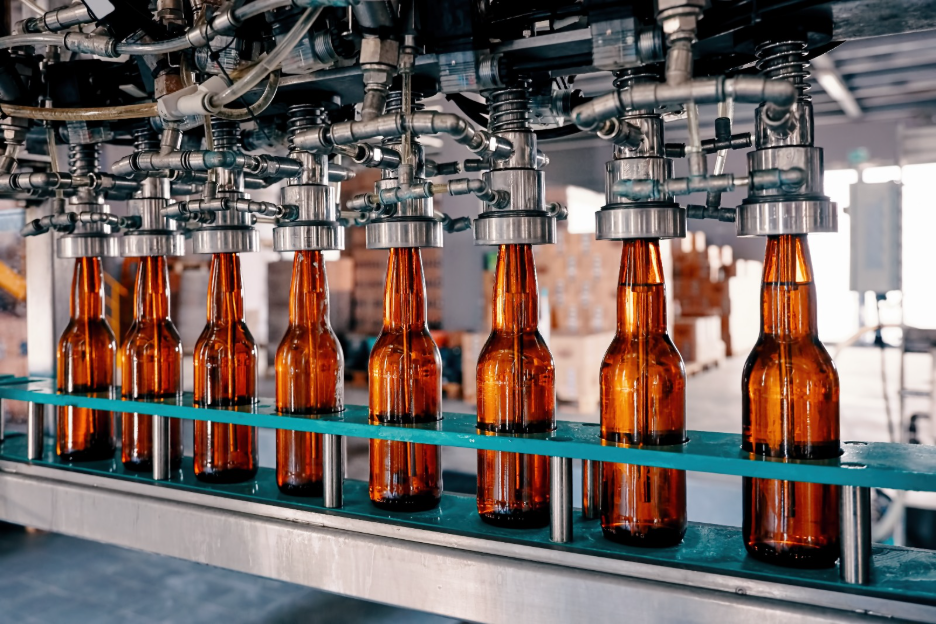
Self-Driving Clean-In-Place for Brewing Operations
In the face of existential headwinds, breweries must rethink their supply chain and operational structure from the ground up. This includes efficiency and sustainability across processes like CIP, filtration, and product changeovers.
Laminar’s Chemical-Process AI helps breweries around the globe future-proof their operations today — before their factories face an operational crisis.
Laminar's sensors and ML models identify product, rinse water, and cleaning chemicals directly inside the process in real time. CIP and changeovers don't just become visible — they run on actual process conditions, with Laminar acting on what's happening at every stage instead of relying on fixed timers or manual verification.
Filtration Optimization
Improved visibility across filtration processes helps breweries stabilize runtimes, reduce unnecessary filter Clean-In-Place cycles, and minimize product loss. Laminar cut Kieselguhr by 42 percent for a brewing customer by deploying process-aware models on their filtration systems.
Clean-In-Place (CIP) Optimization
Many Clean-In-Place systems still operate on conservative timer-based assumptions. Laminar identifies actual clean endpoints in real time and cuts overwash, rinse time, and chemical use.
Changeover Optimization
Rising SKU Counts mean more operation time spent on product changeovers.
Improved visibility during changeovers reduces downtime, minimizes product loss, and reclaims production capacity between runs. Ultimately, brewers send more product to get bottled and waste less water.
Brewing’s Next Era Will Be Defined by Self-Driving Processes
Brewing's next era brings dozens of SKUs through the same lines, tighter margins, and existential resource pressure.
The manufacturers that outcompete won’t just focus on large-scale utility infrastructure projects like wastewater treatment. Leading brewers will capitalize on the opportunities that happen every day on the brewery floor.
Want to learn more about how leading brewers leverage Laminar to achieve greater production efficiency and sustainability? Check out our Brewing One-Pager.
Frequently Asked Questions
What are the biggest challenges facing the beer industry in 2026?
The biggest challenges facing the beer industry in 2026 are rising production costs, water and energy scarcity, SKU proliferation, workforce shortages, and slowing category growth. Breweries are producing more non-alcoholic beer, RTDs, flavored beverages, and seasonal products, increasing operational complexity across manufacturing lines.
As breweries manage more product changeovers and Clean-In-Place (CIP) cycles, operational efficiency and utility usage have become critical business priorities. Many brewers are investing in AI-driven manufacturing technologies to reduce water usage, improve production uptime, minimize product loss, and optimize brewery operations in real time.
How are breweries reducing water and energy usage?
Breweries are reducing water and energy usage by optimizing cleaning processes, improving filtration efficiency, automating process monitoring, and minimizing unnecessary rinse cycles during production. Clean-In-Place systems are one of the largest sources of water, chemical, and energy consumption inside breweries.
Many breweries are adopting real-time process intelligence and AI-based CIP optimization technologies that identify actual clean endpoints instead of relying on fixed timer-based cleaning systems. This helps breweries reduce overwashing, lower utility costs, and improve sustainability across manufacturing operations.
Why are breweries investing in AI and automation?
Breweries are increasingly investing in AI and automation to improve operational efficiency, reduce utility costs, stabilize product quality, and offset labor shortages. Modern breweries operate with more SKUs, more product variability, and tighter margins than ever before, making manual process optimization increasingly difficult.
Technologies like process aware Clean-In-Place, inline sensing, and AI for manufacturing help breweries identify inefficiencies inside production processes, reduce downtime, minimize chemical and water waste, and improve manufacturing consistency across operations.
Related Blog Posts

OTL Ep. 6: F&F Challenges: When the Flavor Wheel Breaks

Clean-in-Place Optimization in Flavors and Fragrances Manufacturing