

Processing Magazine: The Arrival of the Self-Driving Clean-in-Place
.png)
.webp)

.svg)
Food and beverage manufacturers face a quiet and costly problem: their cleaning processes haven’t kept pace with the demands of modern production. Shifting consumer tastes, multiplying SKUs, and tightening sustainability targets are exposing a hard truth: the cleaning cycles running in the background, often unchanged for decades, can no longer keep up. Clean-in-Place (CIP) is the most water and chemical intensive process in most F&B facilities, yet it’s among the last to be modernized.
In a recent article for Processing Magazine, Laminar’s Cassie Orkin traces how clean-in-place technology has evolved from manual disassembly to the AI and sensor-driven system redefining modern manufacturing.
First Steps to Innovation: From Manual Scrubbing to Automated Clean-in-Place
Early industrial cleaning meant tearing equipment apart shift by shift, scrubbing by hand, and soaking components in caustic baths. With outcomes depending entirely on worker diligence, production shifts were lost and contamination was a constant threat. The arrival of automated, closed-loop cleaning in the 1950s and 60s pioneered by the dairy industry changed the game, replacing manual labor with timer-based recipes that could run consistently without human intervention.
However, automation brought its own limitations. Those fixed sequences of rinse, caustic, acid, and sanitizer ran the same way every time, regardless of what needed cleaning. With no way to know when the pipe was truly clean, facilities defaulted to grab samples and swab the pipes at the end of each cycle. As Orkin explains:
Neither outcome is acceptable. Overcleaning isn’t just inefficiency – it’s wasted water, chemicals, energy, and extended downtime, compounding across thousands of cycles every year. The stakes are high for underwash as well, costing the industry billions in revenue when contamination occurs.
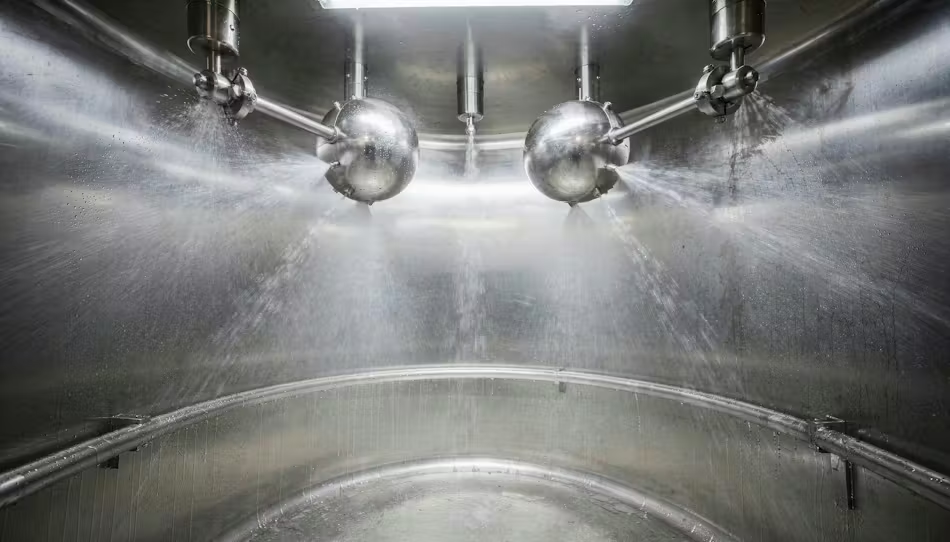
The Next Level: Self-Driving Clean-in-Place
The next level looks fundamentally different than anything that came before. Instead of running a fixed recipe until a timer ends, self-driving CIP leverages advanced sensors and Chemical-Process AI to read what’s happening inside the line, analyze the best course of action, and send commands to the PLC in real time. Orkin describes what that shift makes possible:
The result: every cycle runs as short and efficient as possible – without compromising safety or quality. That’s the shift from yesterday’s optimized CIP to tomorrow’s self-driving CIP.
Laminar and the Future of Process Manufacturing: Self-Driving Clean-in-Place
Laminar developed the infrastructure that makes intelligent CIP real – helping manufacturers do more with less, reduce water consumption, and eliminate contamination risk without relying on yesterday’s playbook. Self-driving CIP closes the loop between real-time process data and cleaning cycles, turning every run into one calibrated to actual conditions rather than assumed worst cases.
For facilities under pressure to produce more, waste less, and meet rising safety demands, the self-driving factory is the next frontier.
Read Cassie Orkin’s full article in Processing Magazine to understand the full arc of CIP evolution – and where the industry goes from here.
Learn how Laminar turns your timer-based CIP into a self-driving CIP.
Related Blog Posts
Clean in Place (CIP): The Complete Guide
From Static CIP to Closed-Loop Optimization: How F&B Plants Get More Agile Instantly


