Brazilian Manufacturing Leaders Visit Laminar for a Masterclass in Physical AI for Manufacturing
.webp)

.svg)
Read our press release here.
Why Physical AI Is Now a Strategic Imperative for Manufacturers
The world’s best manufacturers no longer treat AI as a standalone innovation initiative or digital transformation experiment. AI now functions as operational infrastructure — tied directly to throughput, utility consumption, agility, and competitiveness.
In recent years, several pressures on the factory floor accelerated the shift:
- Rising raw material and utility costs
- Production complexity from SKU proliferation
- Sustainability mandates and resource constraints
- Loss of institutional operator knowledge
- Pressure to improve throughput without footprint expansion
As these macro pressures compound, static recipes, fixed timers, and manual optimization can no longer scale across dynamic manufacturing environments. The manufacturers who pull ahead don't wait for a cleaner roadmap — they treat physical AI as the infrastructure for a future-proofed factory.
Laminar CEO and Co-Founder Annie Lu frames the shift directly:

The “AI Adoption” Urgency of Global Manufacturing Leaders
The conversation around AI in manufacturing crosses every region and every industry. Global manufacturing leaders face the same compounding pressures and the urgency to move from pilot to production at scale grows every quarter.
Sistema FIEP represents the global AI adoption urgency at an industrial scale. One of Brazil's largest industrial federations, Sistema FIEP serves the state of Paraná — a major manufacturing hub in southern Brazil — through four integrated institutions: FIEP, SESI, SENAI, and IEL. Together they represent more than 47,000 industries across 20 productive sectors, responsible for 30% of Paraná's GDP and over 820,000 jobs across food & beverage, cosmetics, construction, forestry, and beyond.
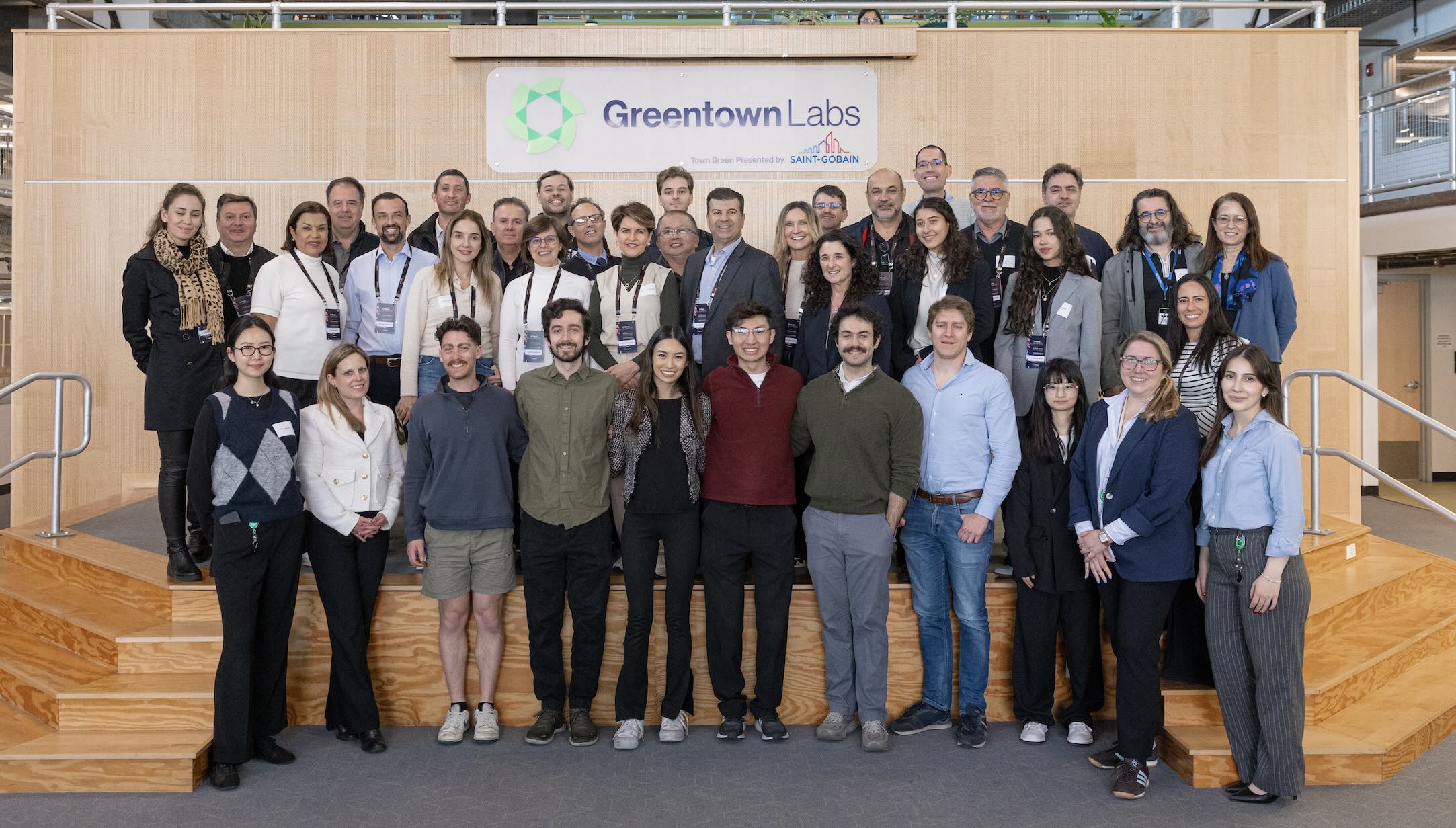
In May 2026, a 26-person delegation from Sistema FIEP traveled to Laminar's headquarters at Greentown Labs in Boston — supported by the U.S. Department of Commerce as part of broader efforts to connect American AI innovators with international industrial partners.
The delegation traveled to Laminar's Greentown Labs headquarters in Boston to see first-hand how Laminar pioneers physical AI in industrial environments — what the technology requires, what holds manufacturers back, and what separates companies that scale from those still on pilot number three.
Why Today’s Factory Floor Demands Physical AI
Manufacturers frequently encounter AI solutions that look strong in a demo and stall in production. The gap between demo and factory floor rarely comes down to vendor execution. Most AI solutions are designed for consumer use — and industrial environments impose constraints that consumer AI was never built to handle.
Every decision on a live production line directly impacts uptime, quality, utility consumption, and product loss in real time. Models must operate reliably under noisy conditions, with constantly shifting process variables, aging equipment, and zero tolerance for failure. A recommendation that arrives too slowly or a model that can't explain its logic has direct cost in downtime and product loss.
The distinction set the foundation for every conversation that followed. Physical AI doesn't improve on familiar legacy tools — it replaces the architecture entirely, built from the ground up for industrial environments.
Laminar explored these themes and more with the Brazil delegation with the goal to support their future AI initiatives back in Brazil.

The Three Layers of a Self-Driving Factory
Laminar CTO and Co-Founder David Lu — the architect of Laminar's machine learning models — anchored his conversation with the delegation around a foundational question: what does it take to move from a smart factory to a self-driving one? The answer comes down to three connected layers working together in real time:
- A sensing layer that captures high-fidelity process data
- An intelligence layer where machine learning models generate predictions and recommendations
- A control layer that feeds decisions back into plant operations autonomously
Most manufacturers have pieces of one or two of these layers. Laminar builds and operates all three.
Shifting AI Adoption from Hype to Execution
Unlike many conversations surrounding AI today, the focus inside manufacturing is becoming increasingly practical rather than futuristic.
The challenge is no longer generating insights alone. Manufacturers evaluate whether AI systems can operate reliably in production environments, adapt to process variability, integrate into existing control infrastructure, and scale across multiple facilities and regions.
Physical AI That Opens the “Black Box”
Explainability was another critical topic covered and is an important requirements for industrial AI adoption.
Operators and engineers increasingly want visibility into why recommendations are being made, especially in environments where decisions directly impact cleaning cycles, production transitions, utility usage, and product quality. Rather than treating AI as a “black box,” manufacturers are prioritizing systems that provide operational transparency and build trust on the factory floor.
Laminar Chief Revenue Officer Sanjay Rajan shared that successful industrial AI deployments depend as much on operational trust as technical sophistication.
Facilities increasingly want process-aware AI systems that integrate naturally into existing workflows rather than abstract software tools disconnected from day-to-day plant operations and the human-operators.
.jpg)
Operational Agility Over Workforce Replacement
AI deployments center less around workforce replacement and more around operational agility, consistency, and the retention of institutional knowledge across increasingly complex production environments. As experienced operators retire, manufacturers need systems that respond to process variability in real time — not static recipes that assume conditions never change.
A veteran operator who walks into a facility and smells a heat exchanger running too hot — fixed before anyone else notices — carries knowledge no recipe documents. When that operator leaves, so does everything they knew. Physical AI captures that expertise, embeds it into the process, and makes it available to every operator who follows.
Laminar Account Executive Cassie Orkin and Forward Deployed Engineer Mahde Alchab work directly with plant teams through this transition — from the first conversation with a skeptical operator to the deployment of models running live on their lines. Their panel with the FIEP delegation tackled one of the most consequential questions in manufacturing AI adoption: how do you build genuine trust with the people on the factory floor?

Why the "Best" AI Solutions Fail to Scale in Manufacturing
Scaling physical AI across global manufacturing operations surfaces a category of challenges that rarely enter the mainstream AI conversation. Hardware logistics, customs coordination, multilingual deployments, PLC integration across legacy infrastructure — these variables determine whether a deployment scales or stalls.
Bobby, Laminar's Director of Customer Success, and Karl, Technical Project Manager, brought field-level perspective to the FIEP delegation on what global deployment looks like in practice. Bobby and Karel manage relationships and deployments across Coca-Cola, Unilever, AB InBev, and dozens of regional manufacturers — across continents, languages, and wildly different levels of operational maturity.
Bobby's approach to every new customer conversation reiterates the tangible impact of physical AI to manufacturers:
The companies scaling physical AI globally aren't the ones with the best algorithm. They're the ones with the operational methodology to back it up.

What Every Manufacturer Should Take from Laminar’s Conversation with Brazil Manufacturing Leaders
For Sistema FIEP, the visit offered a firsthand look at how manufacturers are beginning to operationalize these systems in practice.
The broader takeaway is becoming increasingly clear across global manufacturing: the self-driving factory is no longer a future concept.
Manufacturers worldwide have moved past the question of whether physical AI belongs on the factory floor. The conversation now centers on speed — how fast facilities can move from pilot to full-scale deployment, and what it takes to get there.
Related Blog Posts

From Static CIP to Closed-Loop Optimization: How F&B Plants Get More Agile Instantly
When Manufacturing Expertise Walks Out the Door