COP17 in Ulaanbaatar: Proof Over Promise for Process Manufacturing and Water Security


COP17 in Ulaanbaatar: Proof Over Promise for Process Manufacturing and Water Security
My thoughts on going home to Mongolia, and what it means for the work ahead at Laminar.
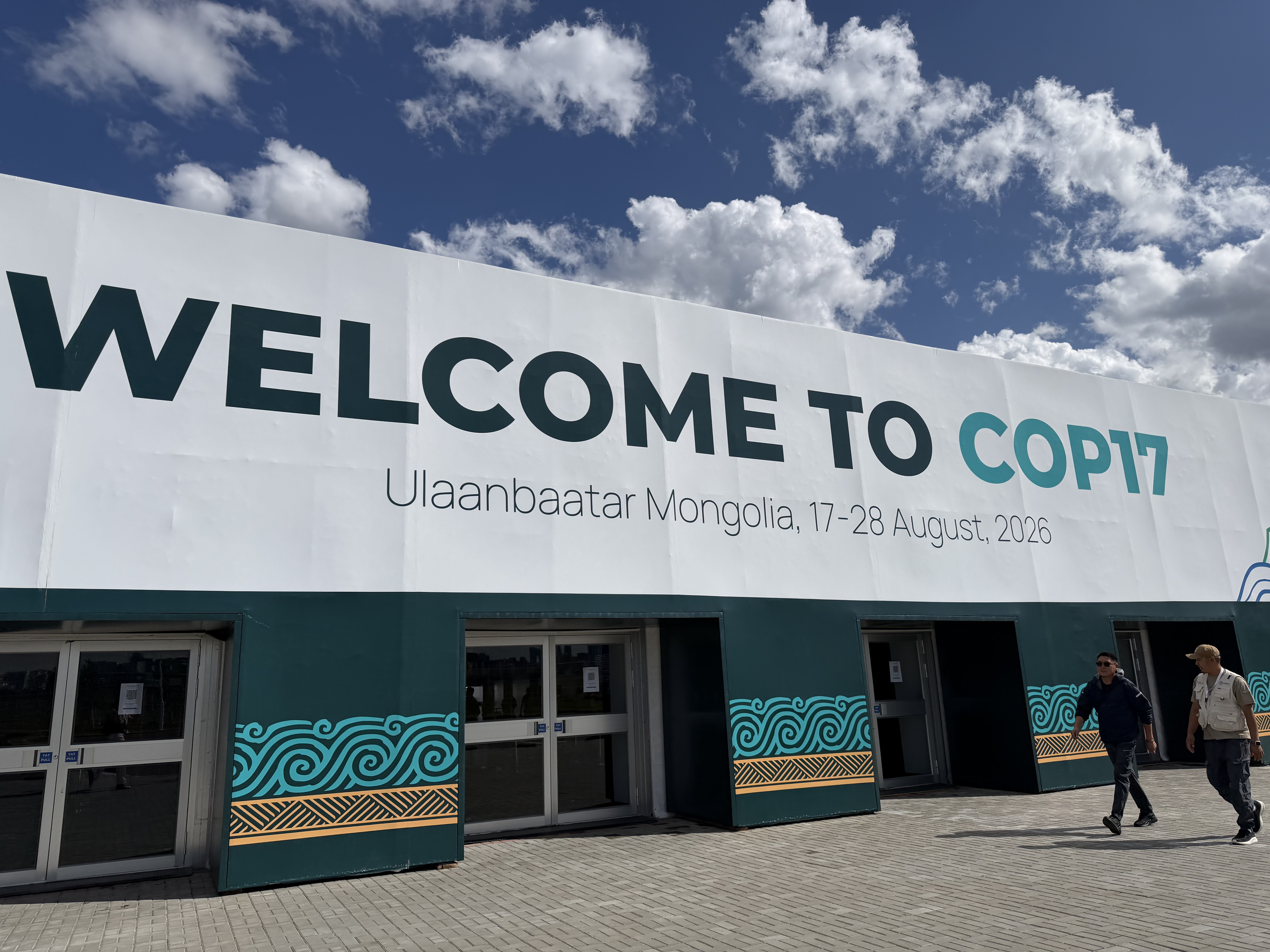
In the Gobi, the desert stretching across southern Mongolia, herders read groundwater by pressing a palm to the earth, feeling for it the way you'd feel your own heartbeat. The practice carries generations of trust in the land, built long before satellites or spectral sensors existed to confirm what the hand already knew. I thought about that image constantly at COP17. This year, the United Nation Convention to Combat Desertification (UNCCD) held its seventeenth Conference of the Parties (COP) in my home country of Mongolia.
I work at Laminar, a physical AI company building self-driving factories for process manufacturers across six continents. Our thesis matches exactly what COP17 argued from every stage: productivity and sustainability grow from the same source. Laminar proves that line by line, turning resource savings into real productivity gains rather than a separate initiative.
Mongolia didn't just show up this year — the country hosted, stepping into responsibility for a crisis it lives daily. Walking into the BlueZone for the first time felt like standing at the center of a conversation this urgent deserved. The BlueZone holds the negotiations themselves, the accredited space where 197 parties shape policy and action. Young Mongolians filled the grounds too, standing for land and water that belong to the whole world, extending far past the steppe outside Ulaanbaatar.
The shape of the conference itself struck me most. Most COPs generate new pledges and new frameworks. This one centered organizations instead— public, private, academic, and smaller businesses working the ground level. Each presented what they had already built, what was working, and what came next. Every case made the same argument twice over: land restoration and water scarcity carry a climate imperative and a real economic return.
How Public-Private Partnerships Are Unlocking Land Restoration Finance
The world isn't short on solutions, it's short on the conditions that let capital move toward them. Investment can't get absorbed at the scale restoration projects need, De-risking has to happen before blended finance can flow in phases, rather than arrive as one high-stakes disbursement.
Blended finance only works once a project shows a track record of stability first — predictable outcomes, credible local partners, and data proving the restoration actually holds. No lender phases capital in behind a promise alone.
UNCCD’s Business4Land exists to build those conditions through public-private partnership. The panel format at COP17 made the point structurally: government, banks, and private sector shared a stage, with academia and international organizations seated in the crowd rather than sidelined from it. The framework organizers kept returning to was the 4 Cs — citizens, cities, countries, and companies — each holding a piece of the solution that none of the others can supply alone.
Pledges are just words, and the only fair judgment comes from the actions behind them. Sustainability projects work only when a company commits to long-term responsibility and thinks in full-cycle terms. Extraction and restoration get planned together from the start, instead of restoration bolted on after the damage is already done. Government support followed the same standard: businesses earn backing by proving necessity and scalability, not by proving good intentions.
Water Scarcity Is a Land Management Failure Before It's a Supply Crisis
Water Day carried the emotional center of the conference, and none of it stayed abstract. Land degradation now touches up to 40% of the world’s land surface and affects over 3.2 billion people. Water sits at the root of nearly every one of those numbers. There is only life when there is water, and the world is losing its freshwater faster than most people realize.
Ministers from water-stressed nations across Africa, Asia, and the Middle East returned to the same sentence, in different words each time: the world manages scarcity, not water. Only about half the water the planet needs exists in usable form. A hydrology professor from the University of Arizona pushed the point further — human decisions drive continental drying, not passive circumstance.
Water management choices accelerate the crisis as often as they solve it. The panel kept insisting that water resists a single color: blue supply gets the attention, but green (soil moisture, vegetation) and gray (treated, reused) water carry just as much of the solution. Most institutions still account for neither.
Why Food and Beverage Manufacturers Should Pay Attention
This framing lands directly in food and beverage and process manufacturing, where water functions as both input and output at every stage of production. MCS Coca-Cola offered the clearest example on the ground in Mongolia: each product currently uses roughly two liters of water, with an active target of 1.7 liters through treated and reused water.
Cleaning alone can account for up to 70% of water use inside a food and beverage plant. Most of it run on fixed schedules, built for the worst-case batch rather than the one actually on the line. Reimagine that single number and the savings compound at a scale most facilities have never measured.
The systems the world built for cleaning, cooling, and dosing were designed for a time when water felt limitless. Times have changed, and the systems deserve first-principles scrutiny.
When Sustainability and Productivity Stop Competing for Budget
The pattern repeated across nearly every business case COP17 put on stage. A coal-to-solar initiative in Ulaanbaatar's ger districts paired solar conversion with carbon financing and grid sell-back, making the sustainability case commercially viable rather than charitable. It carried a business model, not a subsidy request.
Company after company at COP17 made the same case from a different angle: sustainability holds when it comes with a return, and struggles the moment it doesn’t.
How Laminar Improves Productivity and Sustainability Together
Continuous verification replacing a claim is the same conviction driving my work at Laminar now. Process manufacturers have run for decades on fixed timers, worst-case recipes, and grab samples pulled by hand — the same inherited assumption behind so much of the world’s water waste, that the resource would always be there.
Laminar questions that assumption at the source. A team of engineers and scientists built inline spectral sensors that read the live chemistry of a production line continuously. Foundational ML models act on what the system senses in real time, instead of waiting on a schedule designed for the worst case.
Legacy industries that brew, blend, and process rarely get asked to reimagine how they were built in the first place, and that reimagining defines exactly where Laminar operates. Many of the facilities running this technology sit in water-stressed regions, the same regions COP17 spent two weeks discussing. Every liter a line stops wasting is a liter that stays available to the community around it.
When a cleaning cycle runs exactly as long as the process requires and no longer, the water, chemical, and energy savings aren't a program layered on top of production. The savings are the direct output of running the line correctly in the first place, and productivity rises alongside them.
Proof Over Promise: What COP17 Means for Laminar’s Mission
I left COP17 thinking about that herder pressing a palm to the ground, testing what the earth already knew before any instrument confirmed it. Mongolia made a promise when it agreed to host this COP, and backed it with work on the ground long before delegates arrived.
Laminar operates on the same standard, building the Process-Aware Autonomy that makes the same proof possible on a production line anywhere in the world, across legacy industries nobody thinks to question, in the water-scarce regions where the stakes run highest.
Across hundreds of production lines on six continents, deployments have already cut water consumption by 15%, and production cycle times by 20%, with returns landing inside a year. Read our case studies to see the results.
This proof comes from lines running today. Every one of those numbers started as a single line, one cleaning cycle measured in real time instead of run on a worst-case timer, the same way every restored hectare at COP17 started as one plot of degraded land someone decided to prove could hold water again.
Promise opened the door in Ulaanbaatar, but proof is what keeps the investment moving, the land recovering, and the water flowing.

Curious where Laminar is headed next? See where we’ll be.
Related Blog Posts
How our AI-powered technology is combating climate change